1
Module Sends Reference Voltage
The control module often provides a stable reference, commonly around 5 volts, to the sensor.
Electrical Hub • Wiring
Many automotive sensors use the same basic pattern: a reference voltage, a ground, and a signal wire. Understanding that pattern helps you diagnose bad readings, wiring faults, shorts, opens, and sensor failures faster.
Standardized technician view
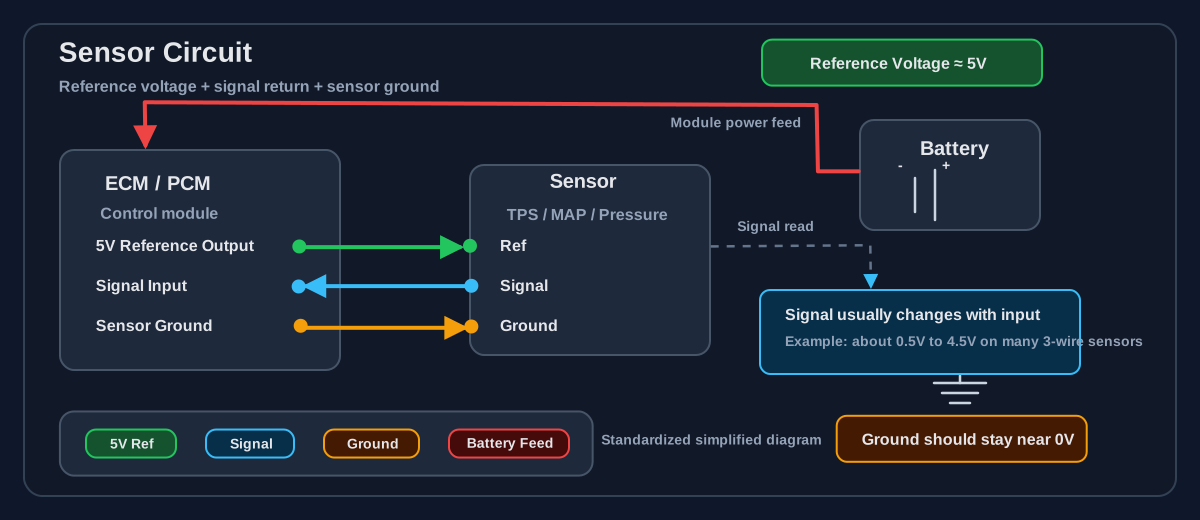
Simple sensor signal view
The control module often provides a stable reference, commonly around 5 volts, to the sensor.
The sensor also needs a clean ground so the signal can be measured accurately.
As pressure, position, or temperature changes, the sensor changes the return signal voltage.
The control module reads that signal and uses it to make operating decisions.
Fast reference
Often about 5V supplied by the module.
Should stay very close to 0V and remain stable.
Usually varies depending on sensor input, often within a range like 0.5V to 4.5V.
The control module watches the signal for expected changes and faults.
Where sensor circuit problems show up
Symptom: Poor throttle response, erratic shifting, or throttle-related trouble codes.
Likely cause: Missing 5V reference, bad ground, or unstable signal voltage.
Check first: Confirm reference voltage, ground quality, and signal sweep as the throttle moves.
Symptom: Hard starting, rough idle, poor performance, or incorrect load calculation.
Likely cause: Signal short, open wire, bad ground, or failed sensor.
Check first: Verify 5V reference, ground, and whether signal changes with engine load.
Symptom: Multiple sensors fail or several unrelated sensor codes appear at once.
Likely cause: One sensor or wire pulling the shared 5V reference down.
Check first: Measure the 5V reference line and isolate sensors one by one if needed.
Fast diagnostic direction
If reference voltage is missing, the sensor cannot report correctly.
A weak sensor ground can create false readings even when power is present.
The signal should respond logically as the input changes, not stay fixed or jump erratically.
Use expected ranges or scan data to decide whether the signal makes sense.
What causes misdiagnosis
Keep diagnosing
Tell us where the repair path needs work: missing services, unclear estimates, pricing confusion, OBD code gaps, repair guide gaps, trust concerns, or feature friction.
Help improve TorqueMech repair intelligence
Tell us what was missing, unclear, or hard to trust so we can improve estimates, OBD paths, and repair guides.